Éclaireur
An autonomous competitive-intelligence AI agent — from a company name to a report of sourced alerts based on official data, with no analyst
Discuss a similar projectThe live site
Click the preview to open and try Éclaireur directly in your browser
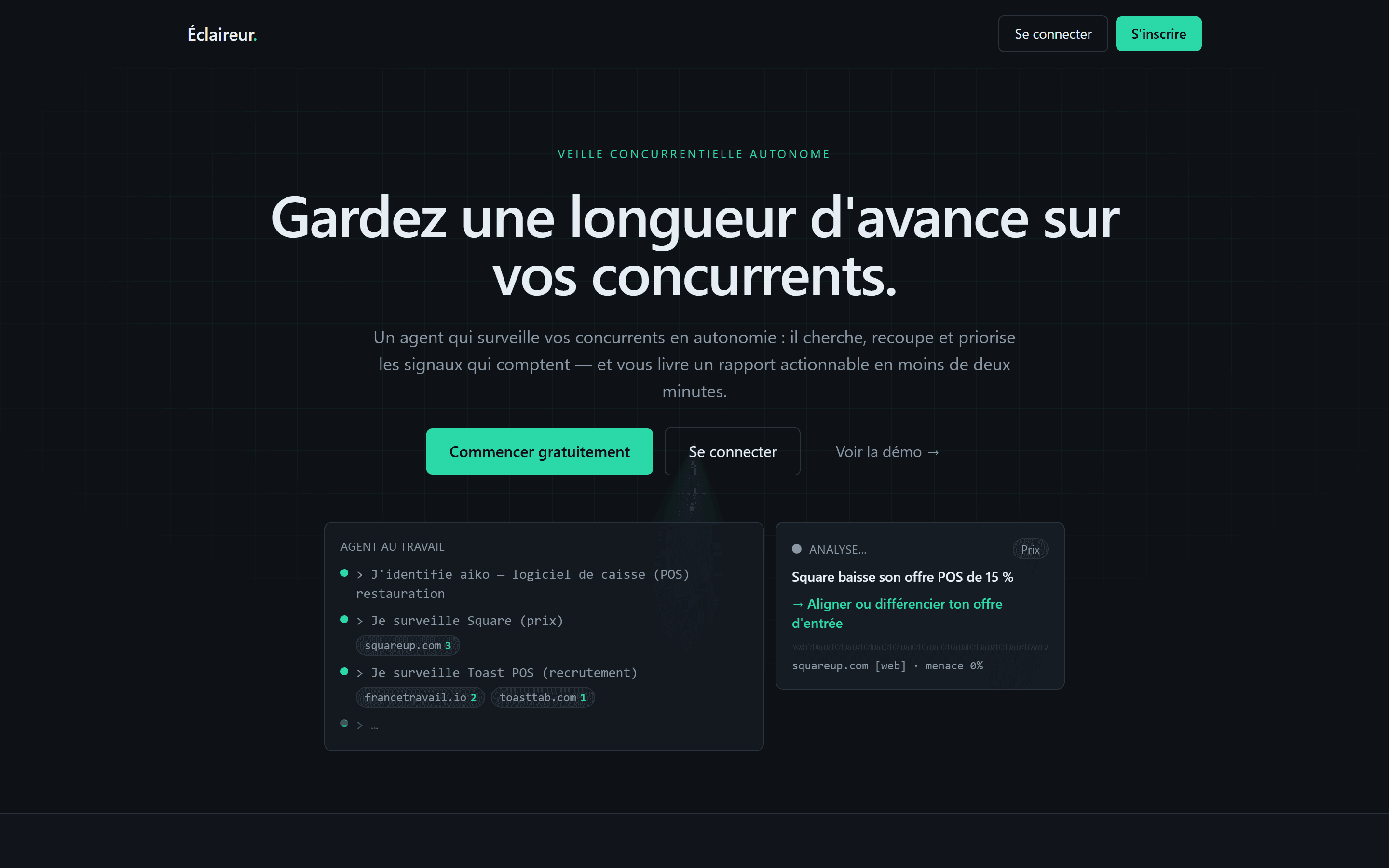
eclaireur-app-production.up.railway.app
Réponse courte
Éclaireur is an autonomous competitive-intelligence AI agent built by Digit-AI during the Vibe Coding Arena 2026 hackathon (brief: 'AI Agents & Automation'). From a company name alone, it identifies the competitors to monitor itself, launches an agentic loop (plan → act → observe) bounded by strict guardrails and a hard timeout, monitors several axes (pricing, products, hiring, communications), scores threats and recommends an action — all sourced from official data (INSEE Sirene, France Travail, Wayback Machine). A deterministic static safety net guarantees the reliability of the demo even in the event of a network or LLM outage.
Competitive intelligence, out of reach for SMBs
Without a dedicated analyst, an SMB leader learns of competitors' moves three weeks too late — when the deal is already lost
B2B SMB leaders have neither the time nor the resources of a business-intelligence team. Competitive moves — a price cut, a new product, a hiring wave — reach them too late and in unverified fragments. Éclaireur was built to give these SMBs a genuinely autonomous monitoring capability, sourced from official data, without turning the leader into an analyst.
No dedicated analyst
The SMB cannot afford a monitoring team; the topic comes after day-to-day operations.
Late, fragmented information
Competitive signals arrive by chance, weeks after the fact, with no sorting or prioritization.
Unverifiable sources
Hard to tell a rumor from official data, so hard to decide with confidence.
Saturated generic tools
Generalist AI agents promise everything and deliver nothing actionable for a specific industry.
Functional scope
B2B SMB leaders in industries intensive in digital signals (consulting firms, agencies, B2B SaaS). Covered processes: entering an objective, competitor discovery, multi-axis monitoring, threat scoring, recommended action, delivery of a sourced report.
Key constraints
Built in 24h (hackathon) · 100% Railway deployment as a single service · Official data on free-tier, with no scraping · Demo reliability as a priority (deterministic static safety net).
What Éclaireur solves
Three areas to make competitive intelligence autonomous, reliable and actionable
End-to-end autonomy
From a company name to the final report, the agent plans, searches, observes and decides on its own, with no manual intervention at each step.
Reliability under constraint
Tight guardrails (≤ 7 iterations), hard timeout and static safety net: the demo holds even when a live call fails or slows down.
Actionable, sourced output
Alerts ranked by salience, a recommended action and displayed provenance (official / web) to decide with confidence.
What Éclaireur enables
From competitor discovery to a sourced report, an agent that does the monitoring work end to end
Autonomous competitor discovery
From the company name alone, the agent proposes the list of competitors to monitor, subject to validation. Fallback: a pre-computed cached list.
Reliable agentic loop
A plan → act → observe cycle with a single search tool at its core, bounded by strict guardrails (≤ 7 iterations, target 3) and a hard per-iteration and global timeout.
Multi-axis monitoring
Monitoring of competitors' pricing, products, hiring and communications, with a recommended action — the "so what", not just a data dump.
Threat scoring
A local heuristic that ranks alerts by salience and highlights red signals, so you get to the essentials in under two minutes.
Official-data enrichment
Cross-referencing with INSEE Sirene, France Travail (job postings) and the Internet Archive (Wayback) — official data only, no scraping.
Static safety net & observability
A deterministic pre-computed report guaranteeing the first 90 seconds, and a real-time timeline (run_steps table polled ~1.5 s) showing the agent at work.
Tech stack
A Python/React single service deployed on Railway, optimized for the reliability of an agentic loop under real-world conditions
Backend & agent
Frontend
Artificial intelligence
Official data
Database
Infrastructure
Distinctive pattern — An agentic loop with a safety net: Éclaireur's value is not a single LLM call but a plan → act → observe loop bounded by guardrails (≤ 7 iterations), a hard timeout and a 100% deterministic static safety net. Every external integration (search, official data) is wrapped behind an explicit stop condition and a fallback — guaranteeing an autonomous demo that never breaks, even offline.
Architecture diagrams
A single Railway service: a React SPA served by a FastAPI API that orchestrates the agentic loop, the integrations and persistence
User
B2B SMB leader
Enters a monitoring objective
Web interface
React 19 + Vite 8 SPA
Objective → report, steps visible live
Service (single Railway service)
FastAPI 0.136 API
Serves the built SPA + /run, /runs/:id endpoints
Agentic core
plan → act → observe loop
Guardrails ≤ 7 iterations + hard timeout
100% static safety net
Deterministic fallback_run.json
Integrations (free-tier)
Claude Haiku 4.5
Tavily / Serper search
INSEE Sirene
France Travail
Wayback Machine
Persistence
PostgreSQL 18
runs · run_steps tables (polling ~1.5 s)
What the prototype demonstrates
Indicators from the prototype presented at the Vibe Coding Arena 2026 hackathon
| Indicator | Classic monitoring | With Éclaireur | Gain |
|---|---|---|---|
| Identifying competitors | Manual search, outdated lists | Autonomous discovery → validation | Automated |
| Time to detect a move | Several weeks (often too late) | On demand, in a single run | Near real time |
| Reliability of the output | Depends on an analyst's availability | Autonomous agent + safety net | Graceful degradation |
| Information traceability | Scattered, unverifiable sources | Every alert sourced (official / web) | 100% |
| Cost of monitoring | Dedicated analyst or provider | Agent on free-tier, with no analyst | Reduced |
Qualitative gains
Real autonomy
The agent receives an objective, plans, acts and reports back with no manual intervention at each step — a genuine agentic loop, not a scripted demo.
Trust through sources
Every alert shows its provenance (official / web badge). The leader can verify the information before deciding.
Demo robustness
Three triggers switch to the static safety net: no network or LLM outage can break the main flow.
SMB verticalization
Designed for B2B SMBs that are intensive in digital signals (consulting, agencies, SaaS) rather than for "every company" — anti-saturation.
Compliance by design
Official data on free-tier, no scraping that breaches terms of use, a systematic deterministic fallback on every integration.
Controlled cost & latency
Guardrails of ≤ 7 iterations and timeouts bound the number of LLM calls, keeping cost and latency under control.